Sunday, 4 May 2008

The Turpin Legend


The name of Dick Turpin is firmly embedded in the British national consciousness, often bracketed together with Robin Hood as heroes who operated outside the law, but who practised a proto-socialist redistributive justice: robbing the rich to give to the poor.

The historian James Sharpe tells the full story in his book, with the self explanatory title Dick Turpin: The Myth of the English Highwayman (London, Profile, 2004). Full credit is given to Ainsworth as creator of the myth, as follows:
'In Rookwood Ainsworth not only created a fictionalised image of Dick Turpin, but also re-created the highwayman as an heroic figure, a gentleman of the road, courageous, brave, an embodiment of English virtues as perceived in the 1830s, an entity whose passing was to be regretted. Our idea of Turpin as a romantic hero, and our broader romantic notions about highwaymen, owe almost everything to Rookwood ... Ainsworth’s greatest literary creation lives on. Dick Turpin, the man whom Ainsworth did so much to reinvent, and whose character he so thoroughly refurbished, remains as familiar and as celebrated as ever. If for nothing else, Ainsworth deserves his place in the cultural history of England for inventing one of those very few historical figures whom all of us recognise. For it is essentially Ainsworth’s Turpin that we remember and celebrate today, not the pock-marked man who swung from the ‘Three-Legged Mare’ at York in 1739.'

Anyone interested in Turpin, highwaymen and/or Ainsworth should grab a copy of this superb book without delay.

A measure of the enduring quality of the Turpin myth is the extent to which it has been absorbed into popular culture. Sharpe covers all this in some detail, including the ‘70s TV series starring Richard O’Sullivan, and unforgettably, Carry on Dick, which featured Sid James (who else?) as the highwayman, who appears in the guise of the Reverend Flasher, in the village of Upper Denture, near York. Barbara Windsor is his sidekick and fellow highwayperson, and Kenneth Williams a Bow Street runner (Captain Desmond Fancy), etc, etc. Great stuff, which illustrates how far the myth can be stretched. Similarly, among the immortal works performed by the great George Formby, can be found two songs, Gallant Dick Turpentine and Dare Devil Dick:

GALLANT DICK TURPENTINE
I'm gallant Dick Turpentine, just swam the Serpentine, now I'm riding to York.
Daring deeds at night I do, holding up coaches, and charabancs too
"Stand and deliver!" I shout and they shiver with faces white as chalk.
I'm such a devil, I scare 'em and then
I rob all the women and kiss all the men.
I'm gallant Dick Turpentine, just swam the Serpentine, now I'm riding to York.
Patter

I'm gallant Dick Turpentine, just swam the Serpentine, now I'm riding to York.
Daring deeds at night I do, holding up coaches, and charabancs too
"Stand and deliver!" I shout and they shiver with faces white as chalk.
I've robbed the mail coach with curses and threats
A couple of bathchairs and two bassinettes.
I'm gallant Dick Turpentine, just swam the Serpentine, now I'm riding to York.

DARE DEVIL DICK
You’ve heard of Dick Turpin and bold Robin Hood, I’m known as one of the click.
A bit of gangster a terror to all, the lads call me Dare Devil Dick.
I’m fond of a fight over fighting I gloat, I’m always the first to hold anyone’s coat.

Dare Devil Dick up to every trick, Dare Devil Dick that’s me
Only last week without saying a word
I travelled first class when my ticket was third.
I’m a demon, I’m devil may care, full of villainy.
Full fare on me ticket they soon made me pay.
But I got me own back the very next day.
I bought two first class tickets and walked all the way.
Dare Devil Dick that’s me.

Dare Devil Dick up to every trick, Dare Devil Dick that’s me
With a girl on a raft I was wrecked on the sea.
I was in a short shirt, and she wore a chemise.
"Hoist a signal" soon she started to shout
"And save us from the sea".
I took off my shirt "They won’t see that" she raved
So I grabbed her chemise, on the mast it soon waved
When she smiled I said "Eee, I don’t want to be saved"
Dare Devil Dick that’s me.

Dare Devil Dick up to every trick, Dare Devil Dick that’s me
For a picnic I went with my sweetie one day
We romped in the fields and we sat in the hay
It was lovely till she cried in alarm.
"Why, there’s a bumble bee".
"Oh be brave and find it", I shouted out "Where?"
She said "Where I’m sitting it’s underneath there"
I got stung on the hand, ah but I didn’t care
Dare Devil Richard that’s me.

Turned out nice again!

Sunday, 20 April 2008

Dick Turpin

The most enduring feature of Rookwood is undoubtedly the account of Dick Turpin’s ride to York, which comprises the whole of Book 4 of the 5-book novel. While Turpin (1705-39) was a real character whose life is quite well documented, his ride to York, to provide an alibi is fictitious, and probably based on an incident in 1676, when a highwayman known as ‘Nicks’ (William Nevinson, see James Sharpe, Dick Turpin: The Myth of the English Highwayman, pp.74-5) is said to have made such a ride for the same reason. Turpin’s famous mare Black Bess was certainly a product of Ainsworth’s imagination, and the story of the ride was the result of an extraordinary burst of creative energy.

The author later described the process as follows:
'The Ride to York was completed in one day and one night. This feat – for feat it was, being the composition of a hundred ordinary novel pages in less than twenty-four hours … from the moment I got Turpin on the high road till I landed him at York, I wrote on and on without the slightest sense of effort. I began in the morning, wrote all day, and, as the night wore on, my subject had completely mastered me, and I had no power to leave Turpin on the high road. Well do I remember the fever into which I was thrown during the time of the composition. My pen literally galloped over the pages. So thoroughly did I identify myself with the flying highwayman, that, once started, I found it impossible to halt.'

Ainsworth had found his literary niche, and from that point until the end of his life, a ceaseless flow of novels poured from his pen. He put aside the business of publishing and when Rookwood appeared in 1834, the three volumes were produced by the firm of Richard Bentley. The reading public immediately took the story to its collective heart, and the book was a runaway success in both critical and popular terms. Ainsworth became the toast of literary London, lionised at gatherings attended by aristocratic patrons of the arts and what would nowadays be called the ‘glitterati’. Various evocations of Dick Turpin strode across the London stage in dramatisations of Rookwood, and Ainsworth’s portrait actually appeared on the new omnibuses to publicise the novel; one of the first examples of this kind of advertising.

Literature and Love


In London, Ainsowrth met a man who was to have a profound influence on both the personal and professional aspects of Ainsworth’s life. John Ebers was a publisher, and proprietor of the Opera House in Haymarket, where the two met and struck up a friendship. Ebers first invited the literary tyro to help write and edit a proposed literary miscellany, which, despite initial enthusiasm, ultimately failed to appear. There were a few trifles of verse and prose, as well as a curious (and now extremely rare) pamphlet entitled Considerations on the best means of affording Immediate Relief to the Operating Classes in the Manufacturing Districts.

More of that later, but the most important factor in the friendship with Ebers, which changed Ainsworth’s life, appeared in the shape of the younger of the publisher’s two pretty daughters (see illustration), with whom the young man immediately fell in love. Fortunately, Fanny Ebers concurred with these sentiments, and the two were married in 1826. They were to have three daughters, Fanny (b.1827), Emily (b.1829) and Blanche (b.1830). However, Ainsworth’s literary social life continued unabated, and in 1835, Fanny returned to live with her father. She died three years later, at the tragically early age of 30.

Friday, 21 March 2008

To London - Ainsworth meets Charles Lamb and his Circle

In 1824, Ainsworth left Manchester to pursue his legal training in London. Although he made a sincere attempt to apply himself to his studies, London’s literary scene proved to be a stronger attraction than the intricacies of conveyancing, and he never returned to his native city, except as a visitor. As soon as he arrived in the Capital, Ainsworth contacted Charles Lamb, who immediately took to the young man, and introduced him to his circle of literary friends. His early impressions of London are well documented in the many letters he wrote to Crossley, and this one from 1825 reveals the uneven struggle between literary social life and the law:

'Little Charles Lamb sends me constant invitations. I met Mrs. [Mary] Shelley at his house the other evening. She is very handsome; I am going to the theatre with her some evening….'

Later in the same letter, he turns his attention, with less enthusiasm, to the family business:

'Before I have completed my year I hope to make myself sufficiently useful…I wish I knew more of common law.'

Ainsworth seems to have been quickly accepted by Lamb’s circle and was by all accounts a lively and opinionated conversationalist. Another friend of Lamb’s described him as ‘forward, talking young man’ and went on ‘he will be a pleasant man enough when the obtrusiveness of youth is worn away a little.' He was eventually admitted as an attorney in the King’s Bench, but never returned to Manchester to practise law, and the family firm eventually lost the Ainsworth name, becoming Crossley and Sudlow.

Tuesday, 5 February 2008

Historical Romance or Gothic Horror?

The all-too-common description of Ainsworth as a writer of 'historical romances' is perhaps a factor which deters many readers today. It might be more interesting to think about our author as a master of the Gothic, following in the tradition of eighteenth-century shockers like Horace Walpole, Ann Radcliffe and 'Monk' Lewis. Indeed, in the preface to Rookwood, the author confesses that 'I resolved to attempt a story in the bygone style of Mrs. Radcliffe (which had always inexpressible charms for me), substituting an old English squire, and old English manorial residence, and an old English highwayman, for the Italian marchese, the castle, and the brigand of the great mistress of Romance'. Many of his novels contain Gothic elements and some would have been worthy of films in the Hammer Horror mould. Given the insatiable public appetite for ghost stories, which has not varied over the centuries, there should be a ready reading public for Ainsworth's work. Here's a brief example from Rookwood, following on from the earlier poetical post about the family legend. Ranulph Rookwood has returned from a continental sojourn to his family home, to attend the funeral of his recently deceased father. He relates the following experience, when he was enjoying the pleasures of a country garden as the evening light began to fade:

"I had been musing for some moments, with my head resting upon my hand,
when, happening to raise my eyes, I beheld a figure immediately before
me. I was astonished at the sight, for I had perceived no one
approach--had heard no footstep advance towards me, and was satisfied
that no one besides myself could be in the garden. The presence of the
figure inspired me with an undefinable awe! and, I can scarce tell why,
but a thrilling presentiment convinced me that it was a supernatural
visitant. Without motion--without life--without substance, it seemed;
yet still the outward character of life was there. I started to my feet.
God! what did I behold? The face was turned to me--my father's face! And
what an aspect, what a look! Time can never efface that terrible
expression; it is graven upon my memory--I cannot describe it. It was
not anger--it was not pain: it was as if an eternity of woe were stamped
upon its features. It was too dreadful to behold, I would fain have
averted my gaze--my eyes were fascinated--fixed--I could not withdraw
them from the ghastly countenance. I shrank from it, yet stirred not--I
could not move a limb. Noiselessly gliding towards me, the apparition
approached. I could not retreat. It stood obstinately beside me. I
became as one half-dead. The phantom shook its head with the deepest
despair; and as the word 'Return!' sounded hollowly in my ears, it
gradually melted from my view. I cannot tell how I recovered from the
swoon into which I fell, but daybreak saw me on my way to England. I am
here. On that night--at that same hour, my father died."

Sunday, 20 January 2008

Early literary efforts continued: The Boeotian

In 1824, Ainsworth ventured to publish a weekly magazine of his own, printed by Thomas Sowler , who was at that time a bookseller in St. Ann’s Square, Manchester, a year before he founded the Manchester Courier. This modest journal was called The Bœotian (Bœotia was a district of central Greece with Thebes as its capital, whose inhabitants were thought of as unsophisticated, even stupid). The journal’s motto was the subject of discussion in the Manchester Review in 1945, when the following explanation was offered: ‘The motto chosen - Boeotum crasso jurares aёre natum, which may be freely translated: “You would swear that he had been born in the gross air of the Boeotians” – may be taken as a playful allusion to the atmosphere of the editor’s home town.’ The suggestion implicit in the title seems to be a devotion to plain speaking, and the magazine featured articles and poems from Ainsworth’s own pen, and those of his friends James Crossley and John P. Aston. Some of these were reprinted from other sources, such as Crossley’s piece On Chetham's Library, which had originally appeared in Blackwood’s Magazine three years earlier, in 1821. Only six issues were published, (March 20-April 2), and copies are now extremely rare.

Thursday, 27 December 2007

The Christmas Box

I haven't been able to find any Christmas stories in Ainsworth's novels (though perhaps a more assiduous scholar may be able to correct me). However, he did publish a short-lived journal entitled The Christmas Box, an annual, which ran to two editions, in 1828-9. The first was notable in that Ainsworth was able to persuade Walter Scott to contribute a ballad, The Bonnets of Bonnie Dundee, and Charles Lamb provided Verses written in the first leaf of Lucy Barton's Album. Other writers (including Theodore Hook, John Gibson Lockhart and William Maginn) furnished the remainder of the stories, and Ainsworth himself added a new tale: The Fairy and the Peach Tree.

The precocious young publisher insisted on paying Scott twenty guineas for Bonnie Dundee, which the revered author accepted with a smile, and handed over to his little granddaughter, Charlotte Lockhart.

In February, 1828, Ainsworth claimed, in a letter to his friend James Crossley: 'The Christmas Box sells admirably; we have already exceeded 2000.' The next volume, in 1829, was published by John Ebers (Ainsworth's father-in-law) and was the final appearance of this title, copies of which are now very scarce.

For more information on The Christmas Box, see S. M. Ellis, William Harrison Ainsworth and his Friends(London, John Lane, 1911), vol. 1, pp. 168-172.

Monday, 5 November 2007

Guy Fawkes in Manchester


In Guy Fawkes (1841), Ainsworth recounts a well-known historical event, but one not normally associated with the northwest region of England. Undaunted by such details, the author sets the whole of the first book (entitled ‘The Plot’) of this three-book novel in the Manchester region, specifically placing the plotters in Ordsall Hall, just a few miles from the city centre. The hall was once the residence of the wealthy and influential Radcliffe family, and Ainsworth employs Sir William Radcliffe in a minor role, giving him a beautiful daughter Viviana, who later becomes amorously involved with the dashing Guy Fawkes. This is an anachronism, as Sir William died in 1568; Viviana, if she had existed, should have been the daughter of Sir John Radcliffe (1581-1627). Such pedantic details were of no concern to Ainsworth, who went on to introduce two other local characters into the story: Humphrey Chetham, the Manchester merchant and philanthropist (founder of Chetham’s Hospital and Library), and Dr John Dee, at that time the Warden of Manchester who is introduced as ‘divine, mathematician and astrologer, - and if report speaks truly, conjuror.’ Ainsworth’s preferred modus operandi always involved a basis of fact, usually gleaned from authentic documents (supplied by James Crossley and other antiquarians, often members of the Chetham Society). On that foundation would be constructed elaborate sub-plots and characterisations, linked to a strong, linear narrative, which the reading public found instantly accessible and appealing.

Sunday, 28 October 2007

Early literary efforts

Ainsworth was educated at Manchester Grammar School, but perhaps more importantly, came under the influence at the age of 12 (1817) of a young articled clerk in his father’s firm, named James Crossley. Five years his senior, with a formidable knowledge of Classical and English literature, Crossley had recently moved to the town from Halifax and was lodging at the Ainsworth family home.

The two soon formed a friendship, based initially on shared literary interests, which was to endure throughout their lives. As S.M. Ellis points out in his 1911 biography of Ainsworth, Crossley was: 'one who, by his wider reading and experience, could render material aid in consummating those fantasies and romantic ideas thronging in the fertile mind of the younger boy.' Although Ellis is describing a youthful relationship, the description remained accurate throughout the adult lives of the two men, with Crossley providing the research and background information to feed Ainsworth's imagination as a successful writer of historical romances.

The young Ainsworth was instrumental in organising amateur theatricals, which became part of life at King Street. A small theatre was set up in the basement of the house, and William and his school friends set about staging ambitious productions of the plays that he was already beginning to turn out with impressive speed. Most of the household became involved in one way or another, whether acting, designing and making scenery and costumes, or swelling the ranks of the audience.

Much of Ainsworth’s early work, in the form of essays, short stories and poems were signed with the name Thomas Hall (who had been a fellow schoolboy at Manchester Grammar School), and many of these were published by journals such as Blackwoods, The London Magazine and Arliss’s Pocket Magazine. The editor of this last journal was the recipient of one of the author’s youthful hoaxes. Under the name of Hall, the sixteen-year-old Ainsworth wrote to announce that he had discovered a seventeenth-century dramatist, named William Aynesworthe, introducing him(self) as follows:

'Of all the dramatic writers, one who has met with the least attention, and perhaps deserved the most, is William Aynesworthe. The chaste simplicity of his style, divested of all the ridiculous bombast which characterizes our modern writers; the elegant and rich fulness of his verse, combine to render him a writer worthy to be ranked among the first of our early dramatists.'

The writer goes on to offer specimens of six plays from the pen of his newly discovered genius, presumably resurrected from the King Street basement. Inevitably the editor spotted some anachronisms in the texts, but Ainsworth continued unabashed, offering the plays of ‘Richard Clitheroe’ to the New Monthly Magazine, with similar results. He was to use the surname Clitheroe in one of his most important novels some 30 years later, as we shall see.

Sunday, 16 September 2007

So who was Ainsworth?


The novels of William Harrison Ainsworth are unfamiliar to the majority of readers who enjoy nineteenth century literature today. Yet Ainsworth enjoyed a spectacular success in his own time. The son of a Manchester solicitor, he found the glittering prizes of fame and fortune in the Capital at the age of only thirty. But when fashionable London’s ardour cooled, it was his native city that provided him with the ultimate honour and recognition. But, in the course of the 122 years since his death, his works have fallen almost completely from the favour of the reading public. Up until the 1940s and 50s the better known titles were available in pocket editions, published by Everyman and similar presses, but nowadays, Ainsworth’s novels are difficult to find. A few are printed in limited quantities by local publishers, and others are available as special ‘print on demand’ items obtainable through the Internet, but the majority of the forty titles in the Ainsworth canon are only to be found in remote corners of second hand bookshops. This situation requires some explanation; so, let us take a closer look at the remarkable story of Ainsworth’s life and work, beginning with his family background in the latter part of the eighteenth century.

William’s father, Thomas Ainsworth, was a descendant of the Ainsworths of Tottington, near Bury, about 2 miles from the village of Ainsworth (the original Ainsworths of Ainsworth had died out shortly after the Civil War). He was born in Rostherne, Cheshire, in 1778, but spent his adult life in Manchester, where he was a partner in the successful legal practice of Halstead and Ainsworth in Essex Street. In the course of his professional life, he was involved with many of the public improvements in the city most notably the radical remodelling of the Market Street area. The author’s middle name was provided by Ann Harrison, who was born in Kirkham in the same year as Thomas Ainsworth. Ann was the daughter of the Rev. Ralph Harrison (1748-1810), who had been minister of the Cross Street Chapel since 1771 and became professor of Greek, Latin and ‘polite literature’ at the newly established Manchester Academy in 1786. The academy moved to Oxford in 1889, and was henceforth known as Manchester College, where there is a memorial window by Burne-Jones in memory of the Rev. Harrison. He also found time to take an interest in business matters, particularly concerning the growth of Manchester, and made a small fortune through property speculation. In this he may well have come into contact with Thomas Ainsworth, and it is quite possible that Thomas might have met Harrison’s daughter through this business relationship.

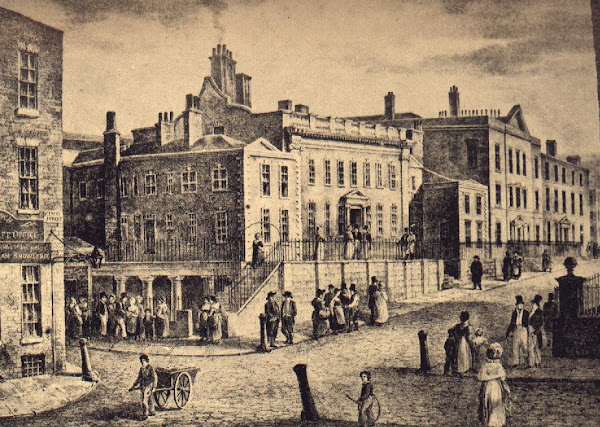
Thomas Ainsworth married Ann Harrison in 1802, and the couple established their home in King Street, at that time a prestigious residential address, in central Manchester(see illustration below). They had two sons: William Harrison Ainsworth (b.1805), and Thomas Gilbert Ainsworth (b.1806), who won a scholarship to Cambridge, but there suffered what was described as ‘brain fever,’ which left him mentally impaired until his death at the age of 70. The Ainsworths also owned a country residence, named Beech Hill, in Smedley Lane, Cheetham Hill (see illustration above), which Thomas purchased in 1811. This location was described as: ‘charmingly situated on high ground, and only a distant glimpse of Manchester was presented across the intervening gardens and fields. From the back of the house a really beautiful view extended over Crumpsall and Heaton Park – a rich well-wooded country of undulating hills.’ Here it was that the family spent many of their summer months when the boys were young. A subsequent occupant was John Edward Taylor, the founder of the Manchester Guardian, who died there in 1844. During the twentieth century, the house became a Church Army Labour Home, and was eventually demolished. There now stands a modern building; a nursing home, which retains the name of Beech Hill, but sadly without the rural aspect.


More to follow soon ...

Thursday, 6 September 2007

Ainsworth on TV!


Channel 5 screened a documentary on Tuesday 4th September, entitled The Real Dick Turpin: Revealed, featuring the historian Professor James Sharpe, of York University, who is an expert on Turpin. The programme acknowledged Ainsworth as the principal creator of the Turpin legend, in particular the 'Ride to York', and showed this portrait of the author by R. J. Lane.

Sunday, 26 August 2007

The Legend of the Lime-Tree (and the fate of the Rookwoods)

In olden days, the legend says, as grim Sir Ranulph view'd
A wretched hag her footsteps drag beneath his lordly wood,
His bloodhounds twain he called amain, and straightway gave her chase;
Was never seen in forest green, so fierce, so fleet a race!


With eyes of flame to Ranulph came each red and ruthless hound,
While mangl'd, torn - a sight forlorn! - the hag lay on the ground;
E'en where she lay was turned the clay, and limb and reeking bone
Within the earth, with rabid mirth, by Ranulph grim were thrown.


And while as yet the soil was wet with that poor witch's gore,
A lime-tree stake did Ranulph take, and pierced her bosom's core;
And, strange to tell, what next befell! - that branch at once took root,
And richly fed, within its bed, strong suckers forth did shoot.


From year to year fresh boughs appear - it waxes huge in size;
And, with wild glee, this prodigy Sir Ranulph grim espies.
One day, when he, beneath that tree, reclined in joy and pride,
A branch was found upon the ground - the next, Sir Ranulph died!


And from that hour a fatal power has ruled that Wizard Tree,
To Ranulph's line a warning sign of doom and destiny:
For when a bough is found, I trow, beneath its shade to lie,
Ere suns shall rise thrice in the skies a Rookwood sure shall die!

Friday, 24 August 2007

Buying books by William Harrison Ainsworth

If you are interested in reading on from the brief extract below, or in any other novel by this author, do not look in a new bookshop. Go instead to your local second-hand book store, where you will probably find some Ainsworth volumes at very reasonable prices. Alternatively, you could look at www.abebooks.com or www.amazon.com for on-line used bargains. It's great fun to pick up an antique volume of around 150 years old to take you back into the exciting worlds created by WHA.

Good hunting!

Steve

ps, coming soon - a poetical extract from Rookwood, Ainsworth's first novel (see earlier posting).

Wednesday, 8 August 2007

The opening page of Jack Sheppard

Chapter 1
The Widow and her Child.

On the night of Friday, the 26th of November, 1703, and at the hour of eleven, the door of a miserable habitation, situated in an obscure quarter of the Borough of Southwark, known as the Old Mint, was opened;and a man, with a lantern in his hand, appeared at the threshold. This person, whose age might be about forty, was attired in a browndouble-breasted frieze coat, with very wide skirts, and a very narrow collar; a light drugget waistcoat, with pockets reaching to the knees;black plush breeches; grey worsted hose; and shoes with round toes, wooden heels, and high quarters, fastened by small silver buckles. He wore a three-cornered hat, a sandy-coloured scratch wig, and had a thick woollen wrapper folded round his throat. His clothes had evidently seen some service, and were plentifully begrimed with the dust of the workshop. Still he had a decent look, and decidedly the air of one well-to-do in the world. In stature, he was short and stumpy; in person,corpulent; and in countenance, sleek, snub-nosed, and demure.

Immediately behind this individual, came a pale, poverty-stricken woman, whose forlorn aspect contrasted strongly with his plump and comfortable physiognomy. She was dressed in a tattered black stuff gown, discolouredby various stains, and intended, it would seem, from the remnants of rusty crape with which it was here and there tricked out, to represent the garb of widowhood, and held in her arms a sleeping infant, swathed in the folds of a linsey-woolsey shawl.

Notwithstanding her emaciation, her features still retained somethingof a pleasing expression, and might have been termed beautiful, had it not been for that repulsive freshness of lip denoting the habitual dram-drinker; a freshness in her case rendered the more shocking from the almost livid hue of the rest of her complexion. She could not be more than twenty; and though want and other suffering had done the workof time, had wasted her frame, and robbed her cheek of its bloom and roundness, they had not extinguished the lustre of her eyes, nor thinned her raven hair. Checking an ominous cough, that, ever and anon, convulsed her lungs, the poor woman addressed a few parting words to her companion, who lingered at the doorway as if he had something on his mind, which he did not very well know how to communicate.

Friday, 3 August 2007

Three novels to get started

Ainsworth wrote some 40 novels during his long career, but these three were among his greatest and most popular, establishing him as one of the foremost English novelists of the 1830s and 40s:

Rookwood (1834). The first gothic novel with an English setting. Features Dick Turpin’s ride to York on Black Bess - a legend in the making!

Jack Sheppard (1840). The story of the notorious eighteenth-century criminal and Newgate escapologist, victim of the infamous Jonahan Wild. This was Ainsworth’s most successful novel, outselling Dickens at this point in his career. The book sparked off some controversy about the author’s treatment of his anti-hero, and has been described as ‘the high point of the Newgate novel as entertainment’.

Old St Paul’s (1841). A tale of the Plague and the Fire, based on published and unpublished works by Defoe.